Introduction
First introduced by Jeffrey Palermo in 2008, Onion Architecture presents a structured approach to building applications with enhanced testability, maintainability, and flexibility. It aims to address common challenges in traditional architectures like tight coupling and lack of separation of concerns, which often plague 3-tier or n-tier systems.
Tight Coupling vs. Loose Coupling
In a tightly coupled system, components are highly dependent on each other. For example, when one class directly depends on another’s implementation, any changes in one class often lead to cascading changes in others. While manageable in small applications, this becomes problematic in large, enterprise-level systems where frequent changes are inevitable.
Where in Loose coupling, on the other hand, promotes independence among components. Objects interact through interfaces or abstractions rather than concrete implementations. This design minimizes the risk of ripple effects when one component is changed, enabling better scalability and easier maintenance.
Why Choose Onion Architecture?
Traditional architectures, like 3-tier and n-tier, have their strengths but suffer from significant issues:
1. Tight Coupling
These architectures often interconnect business logic, data access, and UI layers, making it difficult to change one without affecting others.
2. Separation of Concerns
While architectures like MVC address this by segregating UI, business logic, and data layers, they fall short by allowing controllers to handle database logic, perpetuating coupling issues.
Onion Architecture resolves both challenges. By centering business logic and models in the core and pushing dependencies outward, it ensures minimal coupling and clean separation of concerns.
Key Benefits of Onion Architecture
1. Improved Maintainability
All dependencies are directed toward the center, making it easier to update or extend individual layers without disrupting others.
2. Enhanced Testability
Each layer can be tested independently, fostering robust unit tests without interference from other modules.
3. Loose Coupling
Layers interact through interfaces, allowing runtime injection of concrete implementations and reducing dependency on specific technologies.
4. Scalable Design
Changes in external dependencies (like UI or databases) are isolated from the core business logic, enhancing long-term adaptability.
Core Principles of Onion Architecture
Onion Architecture is built on the Dependency Inversion Principle, where higher-level modules remain unaffected by changes in lower-level modules. The design follows these key layers:
1. Domain Entities Layer (Core)
This is the heart of the architecture, containing business logic and domain entities. It is completely independent of external concerns like databases or UI.
2. Repository Layer
Handles data persistence logic through abstractions, such as interfaces. It provides a clear separation between the domain and infrastructure.
3. Service Layer
Acts as an intermediary between the UI and repository layers, containing application-specific logic. This layer uses interfaces defined in the domain layer for interaction.
4. UI (Web/Unit Test) Layer
The outermost layer handles user interaction, whether it’s a web UI or API. It communicates with the service layer through interfaces.

Onion Architecture Project Structure
To implement the Onion architecture, we develop an ASP.NET Core application. This application performs CRUD operations on entities. The application holds four projects (refer image below). Each project represents a layer in onion architecture.
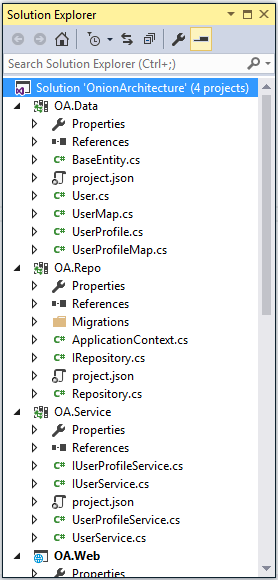
There are four projects in which three are class library projects and one is a web application project. Let’s see each project mapping with onion architecture layers.
1. OA.Data
It is a class library project. It holds POCO classes along with configuration classes. It represents the Domain Entities layer of the onion architecture. These classes are used to create database tables. It’s a core and central part of the application.
2. OA.Repo
It is a second class library project. It holds a generic repository class with its interface implementation. It also holds a DbContext class. The Entity Framework Code First data access approach needs to create a data access context class that inherits from the DbContext class. This project represents the Repository layer of the onion architecture.
3. OA.Service
It is a third class library project. It holds business logic and interfaces. These interfaces communicate between UI and data access logic. As it communicates via interfaces, it builds applications that are loosely coupled. This project represents the Service layer of the onion architecture.
4. OA.Web
It is an ASP.NET Core Web application in this sample but it could be a Unit Test or Web API project. It is the most external part of an application by which the end-user can interact with the application. It builds loosely coupled applications with in-built dependency injection in ASP.NET Core. It represents the UI layer of the onion architecture.
Learned the benefits? I am sure you will consider this architecture for your next project. Now lets see a funny AI generated image that can plug in this article.
Conclusion
Onion Architecture’s layered approach is a game-changer for building modern applications. It not only addresses the tight coupling and separation of concerns issues of traditional architectures but also promotes maintainable, testable, and scalable software design.